Every number here comes with its receipt.
Some numbers we counted ourselves. Some we worked out. Some the platform told us and we could not check. You can always tell which is which, because we mark every one.
Solid, hatched, dotted. Each kind of number has its own mark, and the mark always travels with the number. It's never decoration.
Three ways we know a number
what each mark promises youAn ad we saw ourselves, on a named date. No gaps filled in. If the count is wrong, it is our fault and we can show you the run. The same mark covers a page we captured ourselves and a LinkedIn creative we read from the public library.
- ■ Every number shows the date we looked
- ■ Each channel shows its own latest date, never one date for all
- ■ A captured page carries the country it was fetched from
A spend range we model from the platforms' own reported spend and impressions, priced at a CPM. We show it only where it holds; otherwise a dash and the reason. Media cost only.
- ▨ It holds only when five tests pass on the month: enough of the brand's ads carry reported figures, enough have a dated run, the month holds enough ads, most of the figure rests on reported numbers, and the model agrees with the platform's own figures
- ▨ The band is our own ±30% around the midpoint, not a measured uncertainty
- ▨ No test passed, no number: a dash and the reason, never an invented range
Useful, but borrowed. Start dates, disclosure labels, advertiser names, Google search interest, a visits estimate, a ranking. We pass them on unchanged and mark them, so their weight is never mistaken for ours.
- ◌ Source named at point of use
- ◌ Unverified by us, by design
- ◌ Search interest (Google Trends), site visits (a published estimate), the library's own count: all reported
Two kinds of nothing
these must never look alikeNAB’s live Meta ads at our 7 October check, each one dated.
A figure is a count of what we read. It is never an estimate, and never a claim about what we did not see.
■ Solid border · full-strength figure · timestamp attached
We haven't looked there yet. Don't read this as a zero.
A dashed box means we haven’t looked, so we won’t give you a number.
□ Dashed border · em dash, never a digit · no timestamp to give
What we count, what we read, and what we capture.
Meta, Google Search, YouTube, banner ads and LinkedIn. Each one counts a different object and carries its own date and completeness. We never add them together.
Google Trends interest for the category's buyer terms, weekly, Australia, this quarter against the last. Beside it, the creatives the brands launched in the same weeks.
We read each brand's home page ourselves and compare it with the last time we looked. The date of each read is printed beside it.
A published estimate of monthly visits, beside the ads we counted for the brand. An estimate, marked as one.
A modelled range appears only where five tests pass on the month reported. Otherwise a dash and the reason, on every page and in every export. No spend figure appears in a narrative.
Our model sorts each ad’s message into one of six fixed groups: trust, value, urgency, awareness, lifestyle, security. It reads the product from the ad’s text. You can’t rename or move the groups.
What we haven't measured
the list we keep in publicA gap we have named is worth more than a number we have guessed.
This list grows before it shrinks. When we start scanning a platform, its row stops being dashed and starts carrying dates. We say so on the day it changes.
When we can't say how we know a number
the slot stays empty- □ nothing we could count
- □ nothing to estimate from
- □ the platform told us nothing
If it cannot be marked, it does not ship.
A figure that cannot say where it came from has no place on the page. We leave the slot open and label the refusal, rather than fill it with a figure nobody can defend.
- 01If we can't say how we know a number, we don't show it. The space stays empty and labelled.
- 02An unknown never degrades into a zero, in any view or export.
- 03When coverage arrives, the mark changes on that day and the date is stated.
From our banking example.
- CommBank
CommBank runs on Meta, Search and LinkedIn. Display and YouTube: last seen July, none in our latest read.
- ANZ
ANZ runs on Meta, Search, Display, YouTube and LinkedIn, through DQ&A's account on Display. It also runs through FiveStones' account on Display.
- ING
ING runs on Meta, Search and LinkedIn, through King Kong's account on Search. Display and YouTube: none in our latest read.
- NAB
NAB runs on Meta, Search, Display and LinkedIn, through M Media Group's account on Search and Display. YouTube: none in our latest read.
- Westpac
Westpac runs on Meta, Search, Display, YouTube and LinkedIn, through Publicis Media's account on Search, Display and YouTube.
The offers, in the ads’ own words.

NAB is your partner for growth at every stage of business.
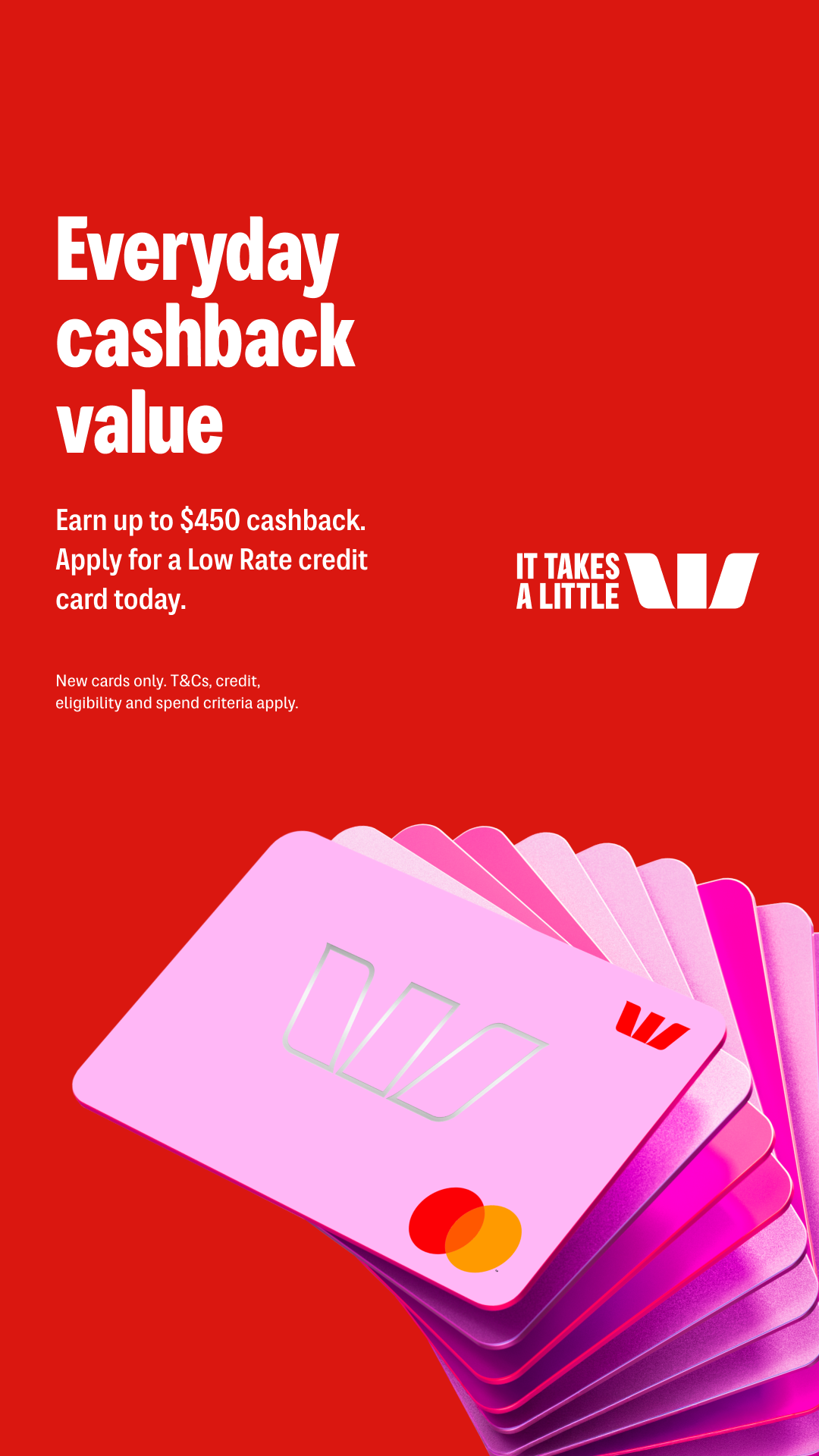
Up to $450 cashback – $75 cashback for every month you spend $1K+ on eligible purchases in the first 6 months of card approval – plus, a low purchase rate. Get more everyday value from a Westpac Low Rate credit card.
Meta publishes none in Australia, so you won’t find a spend number on this page.
Anything set in this face is our read of what the numbers mean.